MataRecycler: A Simple Guide to Recycling, Sustainability, and Smarter Waste Reduction
MataRecycler is a term associated with a simple idea: making recycling easier, more practical, and more useful in everyday life. At its core, MataRecycler can be understood as a recycling-focused concept that encourages people to reduce waste, separate reusable materials, and make better choices about what they throw away.
For many people, recycling sounds simple, but knowing what to recycle, where to put it, and what happens after collection can be confusing. A practical recycling approach can help close that gap. MataRecycler provides a useful way to think about everyday waste management by focusing on simple habits rather than complicated systems.
This guide explains MataRecycler, how recycling works, why recycling matters, common recyclable materials, recycling challenges in the United States, and practical ways households and businesses can improve their recycling habits. It also looks at sustainability, waste reduction, contamination, responsible disposal, and digital information safety for people researching recycling-related services online.
What Is MataRecycler?
MataRecycler refers to a simple recycling solution centered on reducing waste and supporting sustainable everyday practices.
The basic idea is easy to understand. Instead of treating every unwanted item as ordinary trash, people can identify materials that may be reused, recovered, processed, or recycled. These materials can then enter appropriate recycling systems rather than going directly to a landfill.
A useful MataRecycler approach can include:
- Separating recyclable materials from regular trash
- Reusing items whenever possible
- Reducing unnecessary packaging
- Learning local recycling rules
- Properly disposing of materials that cannot go into normal recycling bins
- Supporting products and systems that encourage circular use of materials
- Avoiding contamination of recyclable materials
The important point is that recycling is only one part of responsible waste management. Reducing consumption and reusing products can often be just as important.
Why MataRecycler Matters
The amount of waste produced by households, businesses, schools, restaurants, and other organizations can be significant. When waste is managed poorly, valuable materials may be lost.
MataRecycler is useful as a concept because it encourages people to look at waste differently.
An empty cardboard box, aluminum can, glass container, or certain plastic packaging may not simply be “trash.” Depending on local recycling rules and the condition of the material, it may have another useful life.
This creates several potential benefits.
Reducing Waste
Recycling can keep some materials out of landfills and direct them toward processing and manufacturing systems.
Also Read: Erothto: Digital Communication, Online Search, and Safety
Conserving Resources
Recycling certain materials can reduce the need to obtain additional raw materials. Metals, paper fibers, glass, and some plastics can be recovered and used again.
Supporting a Circular Economy
A circular economy attempts to keep products and materials in use for as long as practical. Recycling supports this system by recovering materials that would otherwise become waste.
Building Better Habits
A simple system can make sustainable behavior easier. When recycling instructions are clear, people are more likely to separate materials correctly.
How MataRecycler Works as a Recycling Concept
A practical MataRecycler system can be viewed as a series of steps.
Step 1: Identify the Material
First, determine what the item is made from.
Is it:
- Paper?
- Cardboard?
- Aluminum?
- Steel?
- Glass?
- Plastic?
- Electronic equipment?
- Food waste?
- Household hazardous waste?
Different materials require different handling.
Step 2: Check Local Rules
This is one of the most important steps.
Recycling rules are not identical across the United States. One city may accept a particular plastic container through curbside recycling while another may not.
Therefore, the recycling symbol on a package does not automatically mean the item belongs in your local recycling bin.
Step 3: Prepare the Item
Some recycling programs require containers to be empty and reasonably clean.
For example, a container containing a large amount of food residue may contaminate other recyclable materials.
Preparation requirements vary by local program, so people should follow their community’s instructions.
Step 4: Separate Materials
Place accepted materials into the correct recycling stream.
Some communities use single-stream recycling, where several types of recyclables are placed in one container. Other systems require residents to separate materials.
Step 5: Collection and Sorting
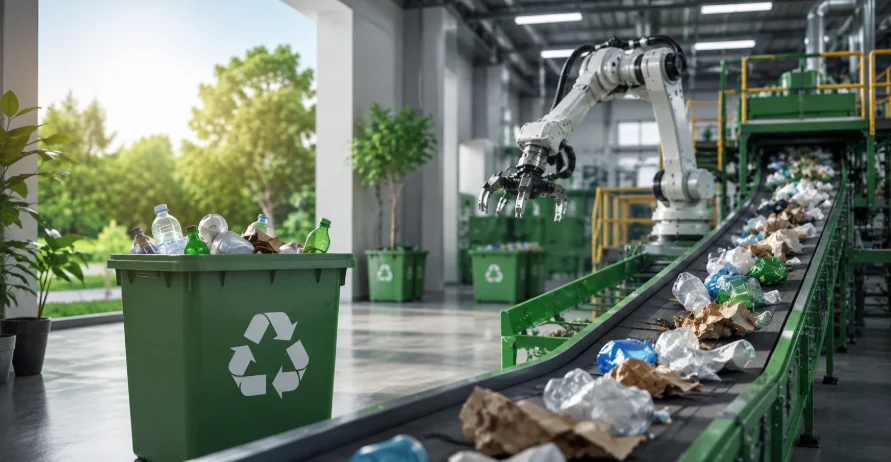
Collected recyclable materials are transported to a facility where they can be sorted and prepared for processing.
Modern facilities may use workers, conveyor systems, magnets, optical sorting equipment, screens, and other technologies.
Step 6: Processing
After sorting, materials can be processed into forms suitable for manufacturing.
Paper may become recovered fiber. Metals can be melted and formed into new products. Glass can be processed into usable glass material. Some plastics can be processed into recycled plastic feedstock.
Step 7: Manufacturing
Recovered materials can become inputs for new products.
This is where recycling becomes part of a larger resource cycle.
What Materials Can Usually Be Recycled?
The answer depends on the local recycling program. However, several materials are commonly accepted in many communities.
Paper and Cardboard
Paper products are among the most familiar recyclable materials.
Examples include:
- Newspapers
- Office paper
- Magazines
- Paperboard
- Corrugated cardboard
- Certain paper packaging
Cardboard should generally be kept reasonably clean and dry.
Large cardboard boxes may need to be flattened before collection.
Aluminum Cans
Aluminum beverage cans are commonly recycled.
Aluminum has an important advantage: it can be recycled repeatedly without losing the basic properties required for many applications.
People should check whether their local program accepts aluminum foil and other aluminum items because acceptance rules can differ.
Steel Cans
Food and beverage cans made from steel are also accepted by many recycling programs.
Examples include:
- Soup cans
- Vegetable cans
- Pet food cans
- Other food containers
Again, local instructions should determine what goes into the recycling bin.
Glass Containers
Many recycling systems accept certain glass bottles and jars.
However, not every type of glass belongs in curbside recycling.
Items such as:
- Drinking glasses
- Mirrors
- Ceramic products
- Certain cookware
- Window glass
may require different disposal methods.
Plastic Containers
Plastic recycling can be more complicated.
Different plastics have different chemical properties, and local facilities may not have the equipment or market demand to process every type.
A plastic item should therefore be evaluated according to local recycling instructions rather than simply its recycling symbol.
What Should Not Go Into a Regular Recycling Bin?
One of the most important parts of responsible recycling is knowing what does not belong in ordinary recycling.
Items that commonly create problems include:
- Plastic bags
- Batteries
- Electronics
- Medical waste
- Needles and sharps
- Chemicals
- Paint
- Household hazardous waste
- Food waste
- Certain plastic films
- Garden hoses
- Clothing
- Broken household items
The correct disposal method depends on the material.
For example, batteries can create fire risks when placed into inappropriate recycling or trash systems. Electronics may contain valuable materials but can also contain substances requiring specialized handling.
Recycling Contamination and Why It Matters
Recycling contamination occurs when unwanted materials are placed into a recycling stream.
This is a major challenge for recycling programs.
Imagine a recycling container filled with paper, cardboard, cans, and bottles. If the same container also contains food waste, liquids, plastic bags, or hazardous materials, the unwanted items can interfere with sorting and processing.
Contamination can:
- Damage equipment
- Increase sorting costs
- Reduce the quality of recovered materials
- Make recycling less efficient
- Cause otherwise recyclable materials to be rejected
This is why “when in doubt, check it out” is a useful recycling principle.
Instead of guessing, residents should check their local recycling provider’s accepted-material list.
MataRecycler and the Importance of Waste Reduction
Recycling is valuable, but recycling should not be the first solution for every waste problem.
A commonly useful way to think about sustainability is the waste hierarchy:
- Reduce
- Reuse
- Recycle
- Recover
- Dispose
The order matters.
If a person can avoid purchasing an unnecessary disposable item, that may prevent waste entirely.
If an item can be reused, reuse may be preferable to recycling it.
Recycling becomes especially useful when an item is no longer practical to reuse but contains recoverable material.
Reduce Before You Recycle
Reducing consumption can be one of the most effective ways to reduce waste.
Households can reduce waste by:
- Buying products with less packaging
- Choosing durable products
- Avoiding unnecessary disposable products
- Planning meals to reduce food waste
- Purchasing only what is needed
- Repairing items when practical
- Using reusable bags and containers
These actions complement a MataRecycler-style recycling approach.
Reuse Before Recycling
Reusing an item gives it another useful purpose without immediately processing it into raw material.
For example, people may reuse:
- Glass jars
- Storage containers
- Cardboard boxes
- Furniture
- Clothing
- Books
- Certain household products
Reuse can also save money.
A product does not always need to be recycled simply because it is recyclable.
Recycling in American Homes
Recycling in the United States varies significantly by community.
Different municipalities can have different:
- Collection schedules
- Accepted materials
- Recycling containers
- Sorting requirements
- Processing facilities
- Contracts with recycling companies
- Drop-off centers
This means that national recycling advice should be treated as general guidance.
For accurate instructions, residents should consult their city, county, waste management authority, or local recycling provider.
Why Recycling Rules Differ by Location
People sometimes wonder why one community accepts an item while another does not.
There are several reasons.
Recycling Facility Technology
Facilities have different sorting and processing equipment.
Local Markets
Recycling depends partly on whether there is a practical market for recovered materials.
Transportation Costs
Moving low-value materials long distances can be expensive.
Material Quality
Some materials may be technically recyclable but difficult to process economically.
Local Contracts
Municipal recycling programs can have different agreements with private processors and waste companies.
Because of these factors, a universal recycling list does not always work.
How Businesses Can Use the MataRecycler Approach
Businesses produce waste from offices, warehouses, stores, restaurants, manufacturing operations, and construction projects.
A recycling-focused system can help organizations manage these materials more effectively.
Businesses can begin by performing a waste audit.
Also Read: Gaymetu E: Digital Identity, Gaming Culture, and Online Safety
A waste audit asks:
- What types of waste are being produced?
- How much waste is generated?
- Which materials are recyclable?
- Which materials are reusable?
- Which materials are contaminated?
- Where does waste leave the building?
- Are employees following recycling procedures?
Once these questions are answered, the organization can develop a practical waste management plan.
MataRecycler for Small Businesses
Small businesses do not necessarily need a complicated sustainability program.
Simple steps can make a difference.
For example, an office might establish separate collection points for:
- Paper
- Cardboard
- Beverage containers
- General waste
- Electronics
- Batteries
Clear labels are important.
A recycling bin with unclear instructions can become a mixed-waste bin very quickly.
Recycling in Schools
Schools are another useful environment for teaching recycling.
Students can learn about:
- Waste reduction
- Resource conservation
- Recycling
- Composting
- Reuse
- Responsible consumption
- Environmental responsibility
A school recycling program can also turn sustainability into a practical learning activity.
Students can track how much paper or packaging is collected and discuss ways to reduce waste.
Recycling and Technology
Technology is changing the way waste is collected and processed.
Modern recycling facilities can use automated systems to identify and separate different materials.
Technologies may include:
- Optical scanners
- Artificial intelligence
- Robotics
- Conveyor systems
- Magnets
- Eddy-current separators
- Digital tracking systems
Artificial intelligence can potentially help identify materials more quickly and improve sorting accuracy.
However, technology does not eliminate the need for good consumer behavior.
If the wrong material enters a recycling stream, sorting technology still has to deal with it.
The Role of Artificial Intelligence in Recycling
AI can support recycling in several ways.
Computer vision systems can identify objects moving along conveyor belts.
Machine-learning systems can help classify materials.
Robotic systems can use these classifications to assist with sorting.
Data analysis can also help recycling operators understand:
- Material volumes
- Contamination levels
- Collection patterns
- Equipment performance
- Operational efficiency
This creates an interesting connection between digital technology and environmental sustainability.
The future of recycling is therefore likely to involve both human behavior and automated systems.
Is Everything With a Recycling Symbol Recyclable?
No.
This is one of the most important facts consumers should understand.
A recycling symbol can communicate information about the material or packaging, but it does not necessarily guarantee that the item is accepted by a local recycling program.
Consumers should distinguish between:
- Material identification
- Recyclability
- Local acceptance
These are different concepts.
An item may technically be recyclable but not accepted by a particular local facility.
Common Recycling Mistakes
Even people who care about sustainability can make recycling mistakes.
Putting Plastic Bags in Curbside Recycling
Plastic bags can interfere with recycling equipment. Many communities require them to be returned to specific collection locations.
Recycling Food-Contaminated Containers
Heavy food contamination can reduce the quality of recyclable materials.
Putting Batteries in Recycling Bins
Batteries may create fire and safety risks in waste facilities.
Recycling Tangled Hoses and Cords
Flexible materials can become caught in sorting equipment.
Assuming All Plastics Are Accepted
Different plastic products can have very different recycling options.
Putting Hazardous Waste in Regular Recycling
Chemicals, paints, and similar materials often require specialized disposal.
How to Build a Simple Home Recycling System
A household recycling system does not need to be complicated.
Start with three basic categories:
Recycling
Items accepted by the local recycling program.
Reuse
Items that can be used again.
Special Disposal
Items requiring drop-off or specialized handling.
Place clearly labeled containers in convenient locations.
Convenience matters.
If the recycling container is difficult to reach, people may choose the nearest trash can instead.
Make Recycling Easy for the Whole Family
A successful household recycling system should be simple enough for everyone to understand.
Use labels such as:
- Bottles and cans
- Paper and cardboard
- Trash
- Special items
Children can also participate by learning which materials belong in each container.
The goal should not be perfection.
The goal should be a system that people can follow consistently.
MataRecycler and Sustainability
Sustainability means meeting present needs while considering the ability of future generations to meet their own needs.
Recycling contributes to sustainability by recovering useful materials.
But sustainability is broader than recycling.
It also includes:
- Energy use
- Water conservation
- Product design
- Transportation
- Food systems
- Manufacturing
- Land use
- Consumption habits
- Waste prevention
MataRecycler can therefore be viewed as one part of a larger sustainability mindset.
Recycling and the Circular Economy
The traditional economic model often follows a simple pattern:
Take → Make → Use → Dispose
A circular economy tries to change this model:
Design → Use → Reuse → Repair → Recover → Recycle → Remanufacture
This approach aims to keep resources in productive use for longer.
Recycling alone does not create a circular economy, but it is an important supporting component.
Environmental Benefits of Recycling
The environmental effects of recycling vary by material and local conditions.
Potential benefits include:
- Reducing landfill waste
- Recovering valuable materials
- Reducing demand for some virgin resources
- Supporting manufacturing inputs
- Encouraging more efficient resource use
However, recycling also requires transportation, energy, equipment, and processing.
This means recycling should be viewed realistically rather than as a solution with zero environmental impact.
The Difference Between Recycling and Upcycling
Recycling and upcycling are related but different.
Recycling usually involves processing a material so that it can become a raw material for another product.
Upcycling involves transforming an existing product into something useful, often without breaking it down into raw material.
For example, turning an old piece of furniture into a new type of household item could be considered upcycling.
Both approaches can help reduce waste.
The Difference Between Recycling and Composting
Composting focuses mainly on organic materials.
Examples include:
- Fruit scraps
- Vegetable scraps
- Yard waste
- Leaves
- Certain food residues
Recycling generally focuses on recoverable manufactured materials such as paper, metals, glass, and certain plastics.
A complete household waste strategy may use both recycling and composting.
How Consumers Can Make Better Recycling Decisions
A simple decision process can help.
Ask these questions:
Can I Avoid Buying It?
If yes, reducing consumption may be the best option.
Can I Reuse It?
If the item is still useful, reuse may be preferable.
Is It Accepted Locally?
Check the local recycling program.
Does It Need Special Disposal?
If it contains batteries, chemicals, electronics, or other special materials, look for an appropriate collection option.
Is the Item Contaminated?
If contamination is significant, follow local instructions instead of assuming it belongs in recycling.
Also Read: Nimedes: Meaning, Uses, Digital Relevance, and What You Should Know
Digital Literacy When Researching MataRecycler
People searching for MataRecycler or other recycling services online should also practice basic digital safety.
Not every website claiming to offer a recycling service is necessarily trustworthy.
Before entering personal information, users should examine:
- The website’s identity
- Contact information
- Privacy policy
- Business information
- Terms of service
- Secure connection
- Reputation
- Claims about recycling services
Users should be cautious if a website demands unnecessary personal information.
Privacy Risks on Recycling Websites
Some websites may request information such as:
- Name
- Email address
- Phone number
- Home address
- Payment information
Consumers should understand why information is being requested before providing it.
A recycling information page generally should not require sensitive personal information merely to explain how recycling works.
Avoid sharing unnecessary financial or identity information with unfamiliar websites.
How to Identify Reliable Recycling Information
Trustworthy recycling information usually has several characteristics.
A credible source should clearly explain:
- Who operates the service
- What materials are accepted
- Where materials can be taken
- What residents should do
- How information is maintained
- How users can contact the organization
Government agencies, established municipal programs, recognized environmental organizations, and established waste management providers can be useful starting points for recycling information.
MataRecycler and Search Intent
The search term “MataRecycler” may attract different types of users.
Some people may be looking for:
- A recycling concept
- A recycling service
- A recycling website
- A sustainability project
- A waste management tool
- Information about a particular platform
- General recycling guidance
This difference matters because a single keyword does not always reveal exactly what the searcher wants.
Good digital literacy means checking the context before trusting a result.
Why Search Intent Matters
Search engines try to understand what users are looking for.
A person searching “MataRecycler” may want a specific website, while another person may be looking for information about recycling.
A useful article should therefore answer basic questions while avoiding unsupported claims.
It is better to explain what is known than to invent details about a company, product, organization, or platform when reliable information is unavailable.
Common Questions About MataRecycler
What is MataRecycler?
MataRecycler is a recycling-focused concept associated with reducing waste, supporting sustainability, and making everyday recycling easier. The term can be understood in the broader context of responsible waste management and material recovery.
Is MataRecycler a recycling company?
The name alone does not establish that MataRecycler is a particular legally registered recycling company. Users should verify the identity and ownership of any specific service or website using reliable information.
What can I recycle?
Common recyclable materials may include paper, cardboard, metal cans, glass containers, and certain plastics. However, accepted materials vary by local recycling program.
Why is recycling important?
Recycling can help recover useful materials, reduce some waste going to disposal facilities, and support more efficient use of resources.
Does recycling solve the waste problem?
No. Recycling is only one part of waste management. Reducing consumption, reusing products, repairing items, composting suitable organic material, and properly disposing of special waste are also important.
Five Frequently Asked Questions About MataRecycler
1. Can recycling save households money?
Recycling itself does not always create direct financial savings for households. However, habits connected with recycling, such as buying fewer disposable products, reusing containers, repairing products, and avoiding unnecessary purchases, can reduce household spending over time.
2. How can apartment residents improve recycling?
Apartment residents can start by learning the building’s recycling rules. They can keep a small recycling container inside their apartment, flatten cardboard, keep recyclables reasonably clean, and use designated drop-off areas. They should also avoid leaving recycling beside an overflowing collection container unless the building’s instructions specifically allow it.
3. Can recycled materials become new products?
Yes. Depending on the material and processing system, recovered materials can become inputs for new products. Paper can become new paper products, metals can be remanufactured, and some plastics can be processed into new plastic products. The exact result depends on the material, contamination, processing technology, and market demand.
4. What happens if recycling becomes contaminated?
Contamination can make sorting and processing more difficult. Some contaminated materials may still be recoverable, while others may be rejected and sent for disposal. High contamination can also increase processing costs and reduce the quality of recovered materials.
5. How can someone start a community recycling project?
A community project can begin with a simple needs assessment. Identify the main waste problems, determine which materials have local recycling options, contact the relevant waste authority, find appropriate collection partners, educate residents, and measure results. Starting with one clear material stream is often easier than attempting to manage every type of waste immediately.
A Practical MataRecycler Checklist
People who want to improve their recycling habits can use this simple checklist:
- Learn your local recycling rules
- Keep recyclables separate from general waste
- Keep accepted materials reasonably clean
- Flatten cardboard when required
- Do not place batteries in ordinary recycling unless your local program specifically allows it
- Keep plastic bags out of curbside recycling unless locally accepted
- Use special collection programs for electronics and hazardous materials
- Reuse products when practical
- Reduce unnecessary purchases
- Teach household members the same system
- Check recycling information before following unfamiliar online advice
The Future of Recycling
Recycling is likely to become more technology-driven.
Automation, artificial intelligence, robotics, advanced sorting equipment, improved product design, and better data systems could help recycling facilities recover more materials.
At the same time, product manufacturers have an important role.
Products designed for repair, reuse, disassembly, and recycling can make the waste system more efficient.
Consumers also have an important role because purchasing and disposal decisions influence the amount and type of waste entering the system.
The strongest recycling systems therefore involve cooperation between consumers, businesses, manufacturers, communities, waste operators, and policymakers.
How MataRecycler Fits Into Everyday Sustainability
The main value of MataRecycler is the simple principle behind the idea: waste should not automatically be treated as worthless.
A used item can sometimes be:
- Reduced
- Reused
- Repaired
- Donated
- Recycled
- Composted
- Recovered
The best option depends on the item.
This way of thinking encourages people to pause before throwing something away.
That small pause can lead to better decisions.
Final Thoughts on MataRecycler
MataRecycler represents a straightforward approach to a much larger issue: how people manage the materials they use every day.
Recycling is not simply about placing a bottle or cardboard box into a different container. Effective recycling requires knowledge, proper sorting, suitable collection systems, responsible processing, and realistic expectations.
The most useful approach is to think beyond recycling alone. Reduce unnecessary consumption when possible. Reuse products when practical. Repair items instead of replacing them when appropriate. Recycle materials that are accepted locally. Use specialized disposal services for materials that do not belong in ordinary recycling.
For anyone researching MataRecycler, the key lesson is simple: responsible waste management begins with informed decisions. By understanding local recycling rules, avoiding contamination, protecting personal information online, and developing consistent household or workplace habits, people can make recycling easier and more effective.
MataRecycler can therefore be understood not only as a recycling-related term but also as a reminder that everyday choices can influence how resources are used, recovered, and kept in circulation.